

An alumni mentoring programme pairs current pupils with former pupils who offer guidance, career insight and a relatable example of where the school can lead. The programmes that last share three things: a verified, school-approved pool of alumni, clear matching and safeguarding rules, and a way to see what changed for pupils. This guide covers each, so you can launch a programme your staff can run without it becoming a second job. Beyond is built for exactly this, working alongside the alumni records you already hold and keeping every introduction under the school's control.
TL;DR
- An alumni mentoring programme can take many forms, from one-off talks to year-long one-to-one pairings. Start with the form your staff can sustain.
- Name a strategic lead and an operational lead, so the programme survives staff changes.
- Match on pupils' needs and aspirations and on mentors' experience, and give every mentor training, a written agreement and safeguarding rules before the first session.
- Set aims and measures at the start, and review them with feedback and outcomes data.
- Keep alumni contact inside a school-controlled system, so verification, permissions and introductions stay with you.
Table of Contents
- What an alumni mentoring programme actually is
- Why former pupils make effective mentors
- Choosing a model your school can run
- Recruiting, preparing and matching mentors
- Structuring sessions so relationships hold
- Safeguarding comes first
- Measuring whether it works
- Where Beyond fits
- A first-year plan
- FAQ
- Sources
What an alumni mentoring programme actually is
The Welsh Government's school and college alumni toolkit describes alumni acting as mentors online or in person, giving advice, support and guidance in a relationship tailored to the individual, with specific goals that help the pupil through a challenge. The same toolkit lists the wider ways alumni contribute: insights into careers and workplaces, co-delivered lessons, assembly talks, and shadowing or placement opportunities.
So "mentoring" covers a spectrum:
- One-off contact: a talk, a Q&A, a careers panel.
- Short-term pairing: a handful of structured sessions around a specific goal, such as university applications or a sector pupils are curious about.
- Long-term mentoring: a regular one-to-one relationship across months.
Most schools begin at the light end and move along it as the alumni pool and staff confidence grow. The decision that matters first is not the format but who in the school owns it.
Why former pupils make effective mentors
Pupils often hear about careers from adults who feel distant from their lives. A former pupil who sat in the same classrooms and had the same teachers is a different proposition. The gov.wales toolkit, drawing on the charity Future First's work, puts it as relatability and sustainability: alumni are "instantly relatable" role models who show that someone like me can succeed, and each year's leavers refill the volunteer pool.
The toolkit says an alumni network builds pupils' confidence and resilience, raises aspirations, enriches the curriculum and supports the careers strategy. It also describes Sydney Russell School using a network of around 300 alumni to deliver workshops, career talks and mentoring, plus a virtual law debate and work experience offers, to raise aspirations and cultural capital.
For the school there is a second benefit. A mentoring programme gives former pupils a reason to stay connected beyond a reunion invitation, which is the point at which many schools lose contact. Every mentor is also a story the school can tell about what its pupils go on to do.
Choosing a model your school can run
The most common mistake is designing the grandest scheme first. Look at three formats and pick by staff time, not ambition.
| Model | What it involves | Best when |
|---|---|---|
| Insight sessions | Virtual Q&As, webinars or talks from alumni | You are starting out or have a small alumni pool |
| Structured one-to-one | Matched pairs meeting over a set period | You can support training, supervision and review |
| Workplace visits and shadowing | Pupils visit alumni at work where feasible and safe | You have alumni in local or regional employers |
Clifton College's alumni page shows all three working side by side. Its Global Mentoring programme draws on 8,600 Old Cliftonians in 102 countries, offering digital insight sessions, structured ongoing one-to-one mentorship, and workplace visits or shadowing where feasible and safe. The lesson for any school is that formats can coexist: a pupil who is not ready for a long pairing can still benefit from a short session.
Who leads it
The gov.wales toolkit recommends at least two leads. A strategic lead sets the aims, builds the network into the school development plan and reviews progress. An operational lead runs it day to day, promotes it and signs up Year 11 and Year 13 leavers before they go. Two people means a staff departure does not end the programme.
That sign-up point deserves emphasis. The easiest time to recruit a mentor is the week they leave, while the school is still the centre of their world. Collect their consent, contact route and a line about what they might want to do next.
Recruiting, preparing and matching mentors
Recruit through an application, not a mass email
The Department for Education's evaluation of peer support pilots found that mentors were typically recruited through an open application followed by an interview to test motivation, maturity and expectations. That pilot concerned peer mentoring on wellbeing, but the principle carries over: a short application and a conversation tell you far more about a prospective alumni mentor than a sign-up box does.
Ask three things: why they want to mentor, what they can offer (sector, route, experience), and how much time they can give. Then verify that they are who they say they are and attended your school. This is where a managed alumni record matters: introductions can only be as trustworthy as the list behind them.
Match on needs, not just job titles
The Greater London Authority's Mentoring Quality Framework sets a matching standard (4.2): the process should take into account the interests, opinions, needs and aspirations of young people alongside the skills, experience and cultural competencies of mentors. It suggests surveys, questionnaires or assessments, matching events, online matching data and minutes from matching meetings, plus equality, diversity and inclusion training.
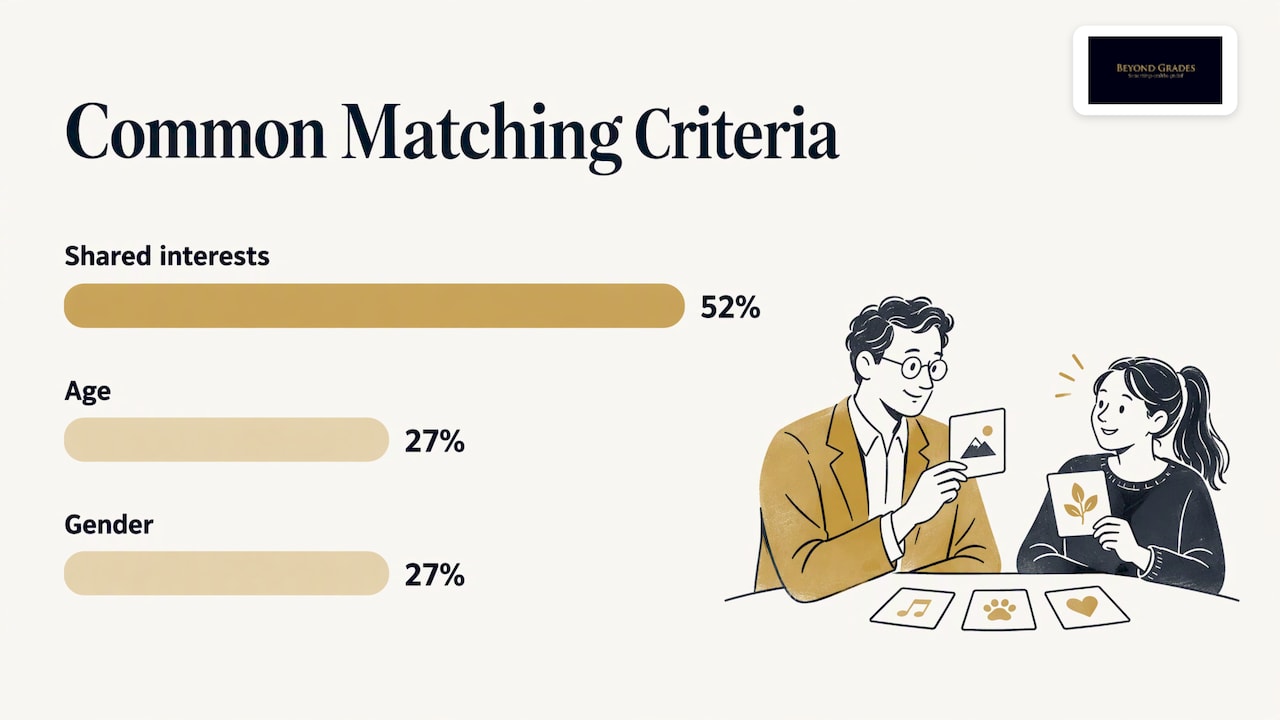
The DfE evaluation found the matching criteria used most often were shared interests (52%), age (27%) and gender (27%), and that matches were seen as most successful when young people led them and when they were combined with informal group activities. The Investate review of the Youth Futures research adds that matching on a similar socio-economic background improved relationship quality and outcomes, and that recruiting a diverse mentor pool and, where possible, letting mentees choose their mentor is recommended.
A practical approach for a school:
- Ask each pupil for two or three interests or questions, in their own words.
- Shortlist two or three alumni who fit, using the mentor application.
- Let the pupil choose, with a member of staff confirming the pairing.
- Record the reason for the match, so you can review it later.
Structuring sessions so relationships hold
A pairing without structure fades after two meetings. The GLA framework (standard 4.3) asks for guidance on handling relationship challenges: training on positive relationships, communication and social media use, a signed relationship contract setting out expectations, guidance for when a relationship breaks down, and guidance on handling dependency.
A workable agreement covers how often you meet, where (online or in school), what is and is not shared, and how either side can end the arrangement without awkwardness.
What a real schedule looks like
Francis Holland School, Regent's Park, launched an alumni mentorship scheme in September 2021 for Lower Sixth pupils joining from another school. Sessions were weekly online Teams meetings, reducing to fortnightly and then monthly from January to July 2022, with a focus on career development, resilience and academic focus. The tapering pattern is useful: intensive early contact builds trust, then the pupil gradually takes ownership.
How long it should run
The Investate review reports the Youth Futures assessment found mentoring works best with at least six months of at least weekly contact, with 12-month programmes the most effective, and that relationships ending within three months were linked to drops in self-worth. If your capacity only allows a short programme, be honest with pupils about its length from the first session, and set an agreed end rather than letting it drift.
Safeguarding comes first
Any programme that connects adults with pupils needs its safeguarding rules written before the first match. Follow your own safeguarding policy and your designated safeguarding lead's advice; the examples below show what good practice contains.
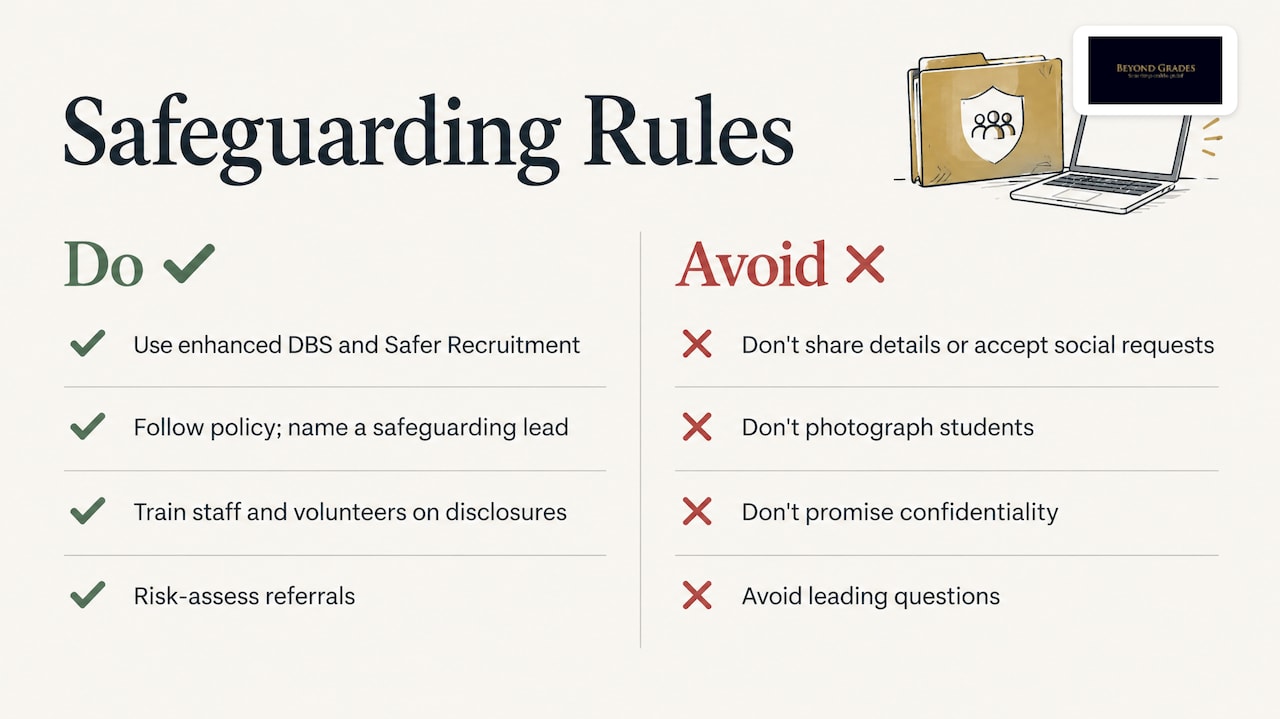
The GLA framework's safeguarding standard (2.3) calls for an enhanced DBS checking process, Safer Recruitment practice, a signed and regularly reviewed safeguarding policy naming a designated safeguarding officer, training for all staff and volunteers on handling disclosures, and risk assessment of referrals.
The gov.wales toolkit gives alumni volunteers clear rules: act professionally, do not give out personal contact details or accept social media requests, do not take photos of students, and declare any existing relationship with a student. If a mentor suspects a child is at risk, they should not promise confidentiality, should stay calm, avoid leading questions, and tell a member of staff discreetly at the earliest convenient moment. The school's safeguarding policy always takes precedence.
Queen Elizabeth's School, Barnet shows how a school can build this into its set-up. Its OE Mentoring programme, launched in January 2022, restricts mentees to Years 12 and 13, requires all mentoring to happen inside the school's own platform with direct messaging and video calling, and asks mentors to refer any wellbeing concerns to the school rather than act as counsellors.
The principle is straightforward: keep conversations inside a channel the school controls. Beyond is designed around this, with alumni participation and introductions remaining under institutional control. You can read how it approaches this on the Beyond safeguarding page.
Measuring whether it works
Decide what success looks like before you start. The GLA framework requires programmes to set out aims, objectives and outcomes with measurement tools (standards 1.1 and 1.2), to identify the target group and their needs (1.3), and to review and adapt the design using feedback and outcomes data (1.4).
For a school, a useful set of measures is small and repeatable:
- Participation: how many pupils were matched, how many sessions took place, how many pairings reached their planned end.
- Pupil feedback: a short before-and-after survey on confidence, clarity about next steps and knowledge of the routes open to them.
- Mentor feedback: what they offered, what they would change, and whether they will return.
- Destinations: where participating pupils go next, tracked alongside the wider alumni record.
The Youth Futures Foundation's Career Ahead feasibility study shows evaluation in practice. It followed an 18-month school-based programme for Year 11 pupils at risk of NEET status (not in education, employment or training), combining group sessions, mentoring, work experience and follow-on mentoring. In the second cohort, 51 of 58 pupils (88%) were retained to the end of Year 11, and the team made improvements as it went, including a taster session, monthly training and extra safeguarding support. The point for your school is the cycle: measure, adjust, run again.
Where Beyond fits
Most of the work above depends on one asset: a reliable, verified list of former pupils who are willing to help, with the school deciding who is introduced to whom. Beyond is an alumni engagement platform for schools and universities. It offers verified alumni profiles, year-group networking, mentoring and speaker connections, masterclasses and outcomes reporting, and it works alongside the alumni database you already have rather than replacing it.
Through The Return, schools can bring in school-approved masterclasses from former pupils, a lighter way to start before committing to one-to-one pairings. Outcomes reporting gives administrators the destinations picture that the measures above need. Beyond is aiming for launch in 2027, and founding schools help shape its development.
If you want to see how this would work for your school, the 20-minute walkthrough for heads is the quickest route, and the Beyond for heads page explains the approach. If you are still weighing up how well you currently stay in touch, the two-minute Alumni Gap Test shows where the gaps are.
A first-year plan
A realistic sequence for a school starting from scratch:
- Term one: appoint strategic and operational leads, agree the aims and measures, and write safeguarding rules with your designated safeguarding lead.
- Term two: collect and verify an initial group of alumni, starting with recent leavers, and run two or three insight sessions or masterclasses.
- Term three: open applications for a small pilot of one-to-one pairings with a training session, a written agreement and a named staff contact.
- Following autumn: review feedback and outcomes data, adjust, and sign up the new leavers before they go.
Keep the pilot small. Ten well-supported pairings teach you more than fifty neglected ones.
FAQ
What do alumni mentors do?
They give a pupil advice, support and guidance around specific goals, whether that is a career path, a university decision or building confidence. According to the gov.wales toolkit, they can also give career talks, help deliver lessons and offer shadowing or placement opportunities. Mentors do not act as counsellors: any wellbeing concern goes to the school.
How long should an alumni mentoring programme last?
The Youth Futures assessment, as summarised by Investate, points to at least six months with regular contact, and 12 months as the most effective length. If your school can only run something shorter, agree the end date up front and use insight sessions or masterclasses for pupils who do not need a long pairing.
How do schools keep alumni mentoring safe?
Use verified alumni, enhanced DBS checks where the role requires them, trained mentors, a signed agreement, and communication only through a school-controlled channel. Mentors should pass any concern about a child to staff straight away and never promise confidentiality. Your designated safeguarding lead should approve the rules.
How much does an alumni mentoring programme cost?
The largest cost is staff time for recruitment, training, supervision and review, so a small, well-supported pilot is the sensible start. If you use a platform, terms with Beyond are agreed with each institution, so speak to the team about your school's size and aims.
Sources
- Setting up your alumni community: school and college alumni toolkit (Welsh Government)
- Mentoring Quality Framework (Greater London Authority)
- Evaluation of the Peer Support for Mental Health and Wellbeing Pilots (Department for Education)
- Clifton College alumni page
- Mentorship that works: what the evidence says (Investate)
- Alumni Mentorship Scheme 2021 launched (Francis Holland School, Regent's Park)
- OE Mentoring (Queen Elizabeth's School, Barnet)
- Career Ahead: Feasibility Study Report (Youth Futures Foundation)